Running a business today means handling many things at once—customer inquiries, emails, sales, payments, follow-ups, marketing, and support. In the middle of all this, one thing often becomes difficult to manage: customer information.
Maybe you have customer details in spreadsheets, emails, WhatsApp chats, or different software tools. One employee knows something, another person doesn’t, and suddenly things start becoming messy. This is exactly where CRM integration makes life easier.
But what does it really mean, and why are so many businesses using it?
Let’s understand it in a simple way.
What Is CRM Integration?
CRM integration simply means connecting your Customer Relationship Management (CRM) software with other business tools and systems you use every day.
Think of it like connecting all the important parts of your business so they can “talk” to each other.
For example, your business may use:
- Email marketing tools
- Billing or accounting software
- Customer support systems
- Social media platforms
- Website contact forms
- E-commerce platforms
Without integration, you may have to manually move data from one system to another. This can waste time and create mistakes. CRM integration automatically connects everything in one place.
For example, when a customer fills out a contact form on your website, their details can automatically appear inside your CRM. No manual work needed.
Why Businesses Struggle Without CRM Integration
Let’s be real for a moment.
Imagine a customer contacts your company for a service quote. Your sales team speaks with them, but later when the customer calls again, nobody remembers the conversation. The customer has to repeat everything from the start.
It feels unprofessional and frustrating.
Or maybe your team wastes hours every week copying customer details from emails into spreadsheets. Sometimes information gets missed, duplicated, or entered incorrectly.
These are common problems in businesses of every size.
When systems are disconnected, work becomes slower, communication suffers, and customers notice the difference.
Why Does Business Need CRM Integration?
1. It Saves Time on Everyday Tasks
Most business owners don’t realize how much time is lost doing repetitive work.
Adding customer details manually, updating records, sending follow-up reminders, or moving information between systems can take hours every week.
CRM integration automates many of these small tasks.
That means your team spends less time doing admin work and more time helping customers or growing the business.
And honestly, nobody starts a business because they enjoy updating spreadsheets all day.
2. Your Customers Get a Better Experience
Customers remember how a business makes them feel.
Nobody likes repeating the same information again and again.
When your systems are connected, your team can quickly see previous conversations, orders, inquiries, or issues. This helps them respond faster and provide better service.
Something as simple as remembering a customer’s last purchase or previous issue can make your business feel more personal and professional.
People appreciate businesses that feel organized.
3. Everything Stays Organized
Many businesses grow faster than their systems.
At first, keeping customer details in notebooks or Excel sheets works fine. But as more customers come in, things become harder to manage.
You may have information spread across:
- Emails
- Contact forms
- Sales software
- Billing systems
- Customer chats
- Social media messages
Trying to manage everything separately can quickly become confusing.
CRM integration keeps customer information connected and easier to find when you need it.
No more searching through endless emails to remember what happened.
4. Your Team Works Better Together
Sometimes the biggest problem inside a business is poor communication.
Marketing gets leads.
Sales follow up.
Support handles complaints.
But if nobody shares information properly, customers end up getting mixed messages.
CRM integration creates a smoother workflow because everyone sees updated customer information in one place.
It feels less like separate departments and more like one team working together.
5. It Helps You Follow Up Without Forgetting
Lost follow-ups can mean lost business.
Maybe someone asked for pricing, requested a callback, or showed interest in your service—but nobody followed up.
It happens more often than business owners like to admit.
A CRM system connected with your emails, website, or communication tools helps track these opportunities.
You can stay on top of leads without relying on memory.
And in business, small follow-ups often turn into big sales.
6. You Make Better Decisions
Sometimes business owners guess what customers want.
But guessing can only take you so far.
When your CRM works with your other systems, you start seeing useful patterns.
You can understand:
- Which services customers ask about most
- Where your leads are coming from
- Which sales methods actually work
- How customers interact with your business
These insights help you make smarter decisions instead of simply hoping for better results.
You Can Also Read : What Is Business Automation? Everything You Need to Know
Common Types of CRM Integration
Every business works differently, and that is why CRM integration is not the same for everyone. Some companies focus on customer communication, while others care more about sales, support, or online shopping. The good thing is that a CRM system can connect with many tools to make daily work easier and more organized.
Below are some of the most common types of CRM integration that businesses use to improve productivity and create a better customer experience.
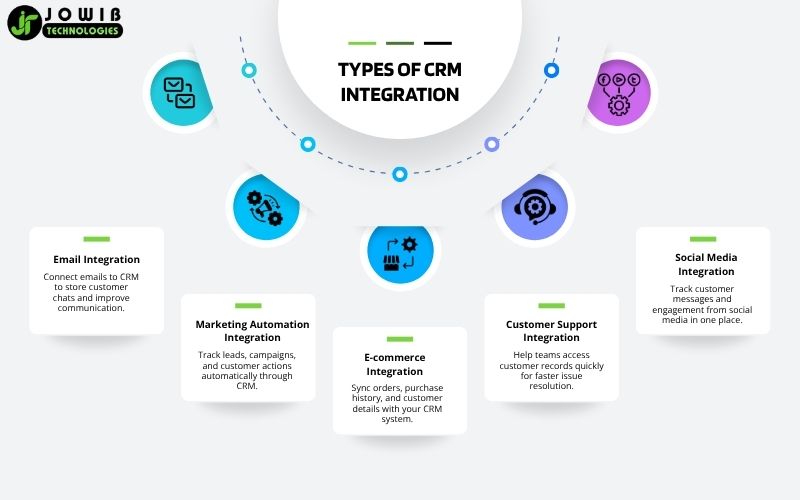
1. Email Integration
Email is one of the most important ways businesses communicate with customers. Without proper organization, emails can easily get lost, forgotten, or scattered across different inboxes. This is where email integration becomes helpful.
When your email system is connected to your CRM, every customer conversation is automatically saved in one place. This means sales teams, support staff, and managers can quickly see previous emails without asking customers to repeat themselves.
For example, imagine a customer contacts your business about a product inquiry. A week later, they email again with another question. Instead of searching through inboxes, your team can instantly view the full conversation history in the CRM.
Email integration helps businesses:
- Keep all customer communication organized
- Avoid missing important follow-ups
- Save time by reducing manual data entry
- Build stronger customer relationships through personalized communication
In simple words, email integration makes customer communication smoother and more professional.
2. Marketing Automation Integration
Marketing is essential for growing a business, but managing campaigns manually can take a lot of time and effort. Marketing automation integration connects your CRM with marketing tools so businesses can track campaigns, customer responses, and lead generation automatically.
For example, if someone signs up for your newsletter or downloads a product guide, the CRM can instantly record their details and place them into a marketing campaign. Businesses can then send targeted emails based on customer interests and behavior.
Think of it like having a smart assistant that remembers customer actions and helps you stay connected without doing everything manually.
Marketing automation integration allows businesses to:
- Track customer engagement
- Manage email campaigns more effectively
- Generate and organize leads automatically
- Understand which marketing efforts bring the best results
This type of integration helps businesses save time while making marketing more personal and effective.
3. E-commerce Integration
For online businesses, keeping track of customer orders and shopping behavior is extremely important. E-commerce integration connects your online store directly to your CRM system.
When a customer places an order, their purchase history, payment details, and product preferences are automatically updated in the CRM. This helps businesses understand customer buying habits and provide a better shopping experience.
Imagine a customer buys shoes from your online store. Later, the business can recommend matching accessories or similar products based on previous purchases. This makes customers feel understood and improves sales opportunities.
E-commerce integration helps businesses:
- Sync customer orders automatically
- Track purchase history in one place
- Improve customer recommendations
- Create personalized shopping experiences
For growing online stores, this integration can make business management much easier and more organized.
4. Customer Support Integration
Good customer support can make a huge difference in how people view a business. Nobody likes repeating the same issue again and again to different team members. Customer support integration helps solve this problem.
When support systems connect with CRM software, customer service teams can instantly access customer records, previous complaints, purchase details, and communication history.
For example, if a customer calls about a delayed order, the support agent can immediately see the order details and previous interactions without asking too many repeated questions.
Customer support integration benefits businesses by:
- Solving customer issues faster
- Giving support teams complete customer information
- Reducing frustration for customers
- Improving customer satisfaction and trust
A smooth support experience often turns unhappy customers into loyal ones.
5. Social Media Integration
Today, customers spend a lot of time on social media platforms. Many people ask questions, leave reviews, or even contact businesses through platforms like Facebook and Instagram. Managing all these interactions manually can become difficult.
Social media integration allows businesses to connect their CRM with social platforms so customer interactions are tracked in one place.
For example, if someone messages your business page asking about pricing, the CRM can store that interaction. Later, if the same person becomes a customer, your business already has a record of the conversation.
Social media integration helps businesses:
- Monitor customer engagement across platforms
- Respond to customer questions faster
- Understand customer interests and behavior
- Build stronger relationships through better communication
This type of integration helps businesses stay connected with customers where they spend most of their time online.
CRM integration helps businesses simplify operations and improve customer experiences. By connecting emails, marketing, e-commerce, support, and social media, businesses can stay organized, respond faster, build trust, and create better customer relationships.
Who Should Use CRM Integration?
The short answer? Almost any business.
Whether you run:
- A small local business
- An online store
- A service company
- A growing startup
- A large company
CRM integration can make customer management easier.
You do not need a huge team or a massive budget to benefit from better organization.
In fact, smaller businesses often see the biggest improvements because every saved hour matters.
How Jowib Technologies Helps Businesses Simplify CRM Integration
Managing customer information across different platforms can become stressful for any business. Many companies deal with scattered customer records, missed follow-ups, repeated manual tasks, and systems that simply do not work together. Over time, this can slow down business operations and affect customer experience.
This is where Jowib Technologies helps businesses simplify CRM integration in a practical and hassle-free way.
Jowib Technologies understands that every business has its own process and requirements. Instead of using a one-size-fits-all approach, they help businesses connect their CRM system with the tools they already use daily. The aim is to create a smooth workflow where information moves automatically between systems without confusion.
By simplifying CRM integration, businesses can spend less time managing data and more time focusing on customers, sales, and growth.
How Jowib Technologies Makes CRM Integration Easier
Jowib Technologies helps businesses connect CRM systems with different business tools, including:
- Website Contact Forms – Automatically collect and store customer inquiries in your CRM.
- Email Platforms – Keep customer communication organized and accessible in one place.
- Marketing Tools – Track leads, campaigns, and customer interactions more effectively.
- Sales Systems – Help sales teams manage leads and follow-ups without missing opportunities.
- Customer Support Platforms – Give support teams quick access to customer information for faster assistance.
Benefits Businesses Can Experience
With the help of Jowib Technologies, businesses can enjoy several practical benefits, such as:
- Less Manual Work – Reduce repetitive tasks and avoid entering the same data multiple times.
- Better Team Coordination – Sales, support, and marketing teams can stay updated with the same customer information.
- Improved Customer Experience – Respond faster and offer more personalized service.
- Better Organization – Keep all customer details connected and easier to manage.
- More Time for Business Growth – Spend less time fixing system issues and more time growing the company.
Whether you are a small business trying to stay organized or a growing company looking for smoother operations, Jowib Technologies helps make CRM integration simple and manageable.
When your systems work together properly, daily business tasks feel easier—and customers notice the difference too.
You Can Also Read : What Is Web Automation and How It Works
Final Thoughts
Running a business is already challenging enough. Managing customer information should not make it harder.
CRM integration is simply about making work easier, communication smoother, and customer experiences better.
It helps you spend less time chasing information and more time building relationships with customers.
Because at the end of the day, people do business with companies that feel reliable, organized, and easy to deal with.
And sometimes, small improvements behind the scenes can make the biggest difference in how customers see your business.